
Organizations rarely struggle because they lack ideas.
More often, the difficulty lies in converting those ideas into clear direction, functional systems, disciplined implementation, and sustained organizational action.


Advice tells an organization what it might do.
Methodology establishes how a complex problem will be examined, how decisions will be made, how implementation will occur, how performance will be evaluated, and how the resulting system will be sustained.
Hinton Consulting develops proprietary methodologies to address those distinct challenges.
Our methodologies provide structured ways to think, diagnose, design, implement, govern, measure, and strengthen organizations.
They are not generic consulting processes.
They are intellectual systems developed to solve different classes of organizational problems.
Together, they form the methodological foundation behind how Hinton Consulting approaches complex organizational transformation.
A strategic recommendation without implementation architecture may never become operational.
A new process without appropriate governance may fail under pressure.
A well-designed operating system can still stall when leadership cannot translate decisions into coordinated action.
Hinton Consulting methodologies are designed around these dependencies.Rather than treating every organizational problem as the same type of problem, we identify which layer requires intervention.
Our methodology portfolio currently operates across four distinct but interconnected domains.
Where are we going?

What must exist for us to get there?
How will we make it operational?
Leadership alignment, decision-making, prioritization, and execution across the system.
Some engagements require one methodology. Others require several. The sequence shown is one possible transformation path.
Some engagements require one methodology.
Others require several.
A complex transformation may move through the methodology ecosystem in sequence.
Establishes direction.
Where are we going?
↓
Determines the organizational architecture required to support that direction.
What must exist for us to get there?
↓
Moves the strategy and architecture into organizational practice.
How will we make it operational, sustainable, and scalable?
Across those stages:
Can be introduced when leadership alignment, decision-making, prioritization, or execution becomes a material variable.
Can leadership consistently move the organization forward?
This creates an integrated methodology architecture without forcing every organization through the same consulting sequence.
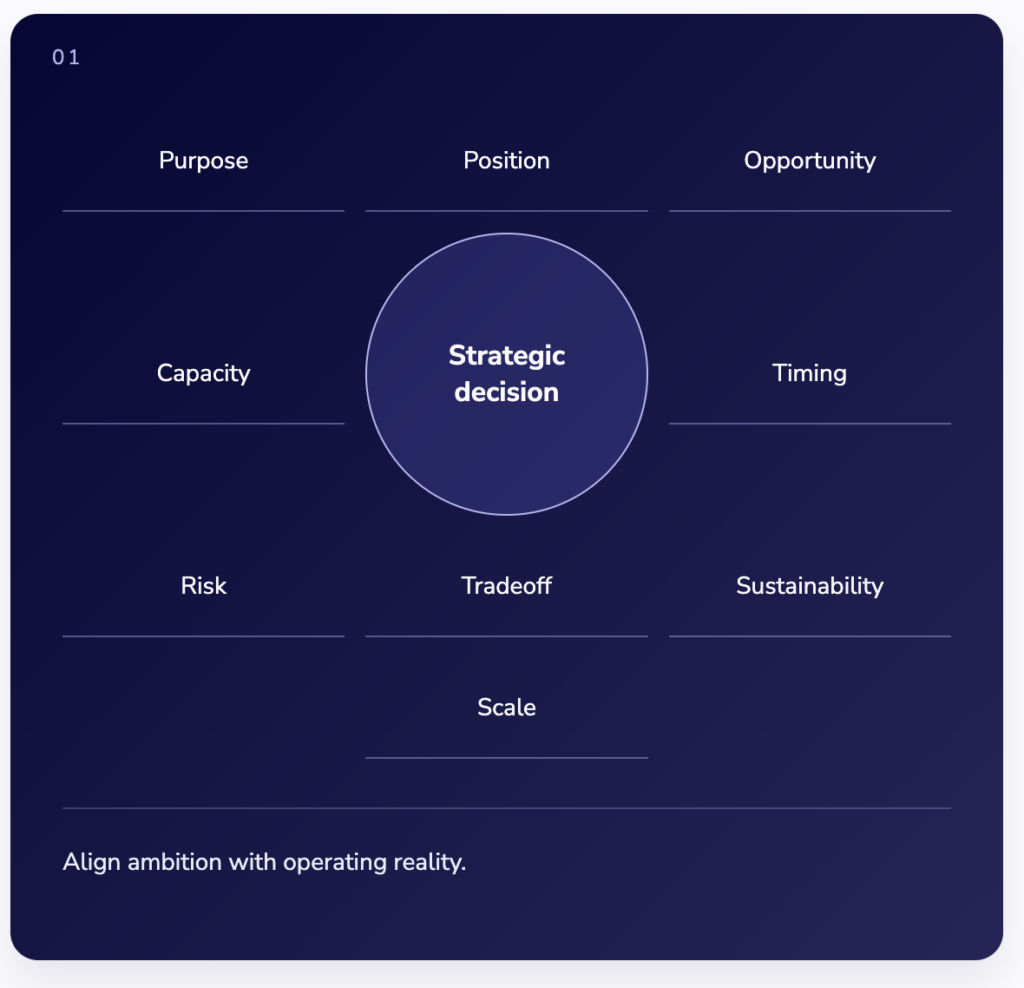
The Hinton Strategy Compass™ helps leaders establish strategic direction, evaluate competing priorities, examine organizational capacity, and distinguish meaningful opportunity from organizational distraction.
It is designed for environments where leadership must make consequential decisions about growth, transformation, investment, expansion, positioning, or competing organizational priorities.
Hinton Strategy Compass™ is Hinton Consulting’s proprietary strategic-intelligence methodology for helping organizations determine where to move next and why.
It evaluates major decisions through interconnected lenses including purpose, position, opportunity, capacity, timing, risk, tradeoffs, sustainability, and scale.
The methodology helps leadership distinguish between attractive opportunities and strategically sound choices by testing each decision against the organization’s actual operating conditions.
Strategy Compass™ is especially useful when navigating growth, expansion, investment, competing priorities, new services, partnerships, transformation, or market positioning.
Rather than producing strategy for strategy’s sake, it strengthens the logic behind executive decisions and clarifies what should move forward, what should wait, what should be redesigned, and what should be declined.
Its purpose is to convert organizational ambition into disciplined strategic direction.
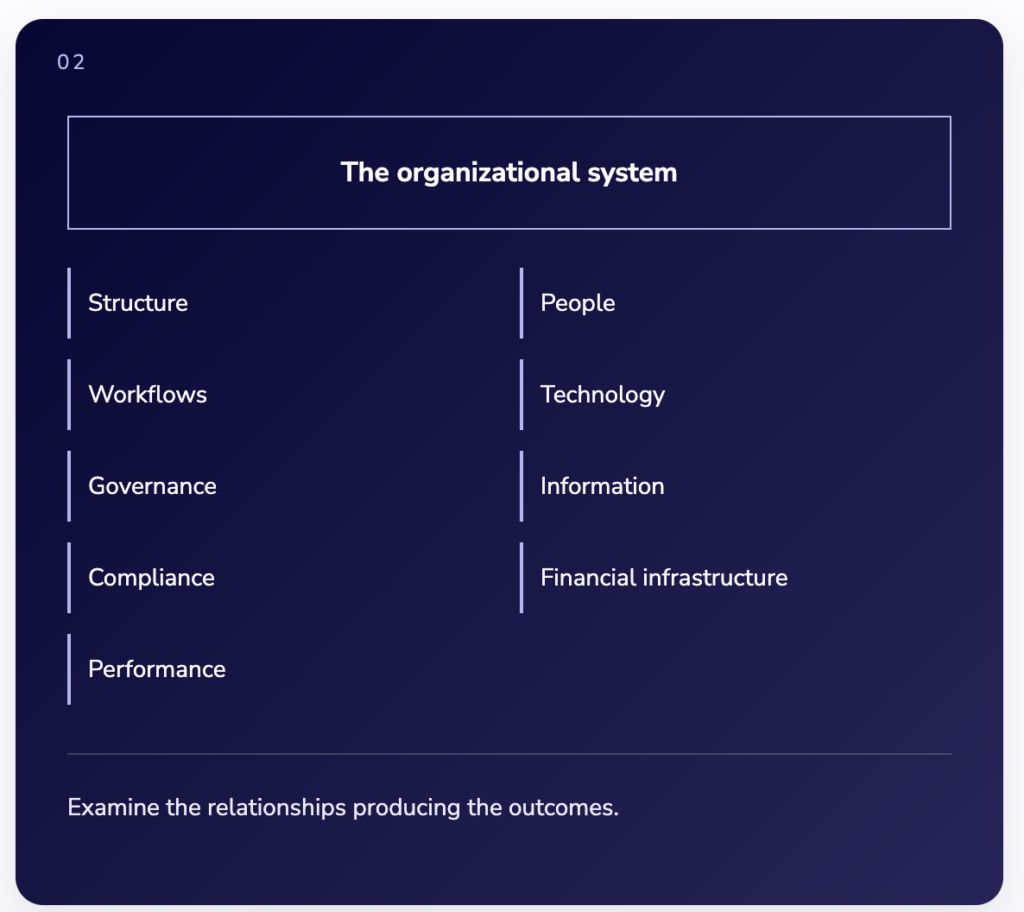
ProSYS™ is Hinton Consulting’s organizational systems methodology.
It examines how structure, people, workflows, technology, governance, information, compliance, financial infrastructure, and performance interact as one organizational system.
ProSYS™ is Hinton Consulting’s proprietary organizational systems-engineering methodology for diagnosing how an organization actually functions beneath its formal structure.
It examines the relationships among people, workflows, governance, technology, information, compliance, financial infrastructure, leadership, and performance to identify the architecture producing current outcomes. Rather than treating recurring problems as isolated issues,
ProSYS™ distinguishes visible symptoms from the structural conditions causing them. The methodology is especially valuable when organizations are experiencing operational bottlenecks, role confusion, founder dependency, compliance instability, fragmented processes, rapid growth, or technology misalignment.
ProSYS™ helps leadership determine what must change, what dependencies must be redesigned, and what operating architecture is required for the organization to function more reliably.
Its purpose is to move organizations from reactive problem-solving toward integrated, resilient, and scalable systems.
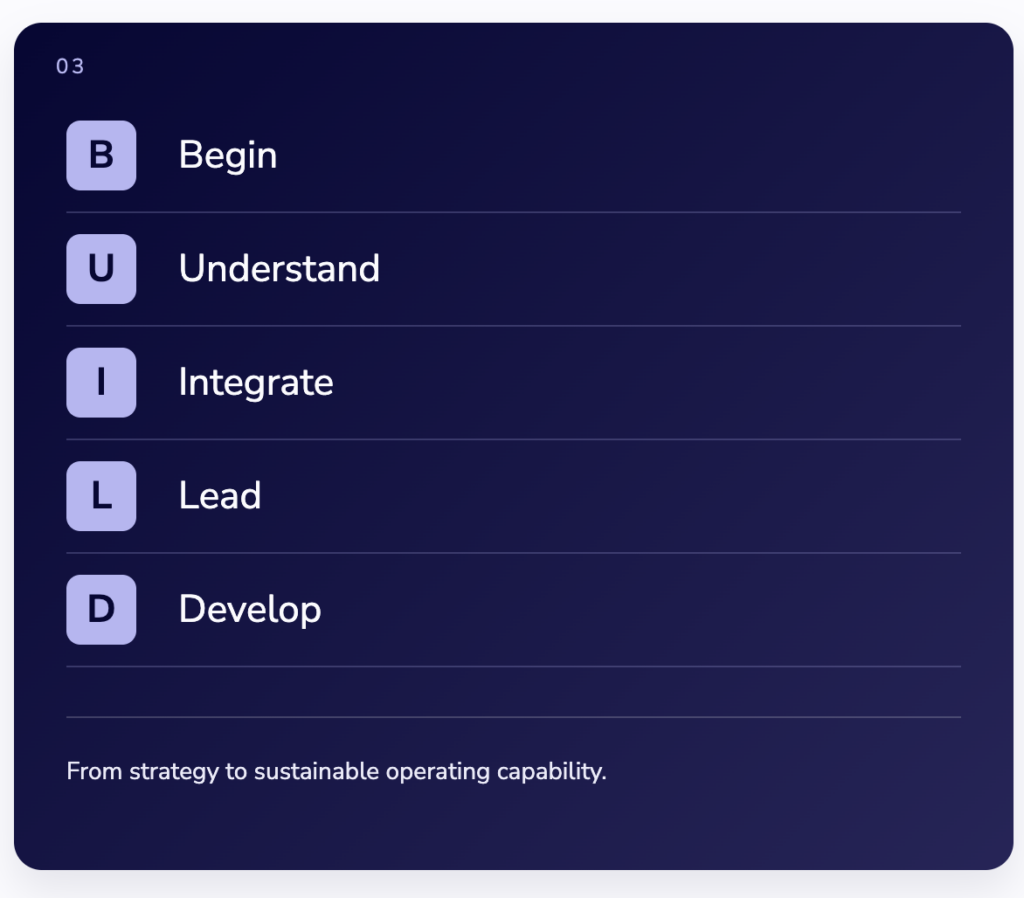
BUILD™ is Hinton Consulting’s disciplined implementation methodology for converting strategies, frameworks, priorities, and leadership expectations into functioning operating systems.
BUILD™ addresses the implementation gap between understanding an initiative and actually institutionalizing it.
BUILD™ is Hinton Consulting’s proprietary implementation methodology for converting strategy, frameworks, organizational priorities, and leadership expectations into functioning operating systems.
It guides implementation through five connected stages—Begin, Understand, Integrate, Lead, and Develop—to establish governance, assess readiness, align existing resources, operationalize the work, build internal capability, and sustain results.
Rather than assuming implementation is complete when people understand a new initiative, BUILD™ focuses on whether the organization can consistently operate it.
The methodology is especially valuable when organizations need to move from planning into execution, integrate new frameworks into existing systems, strengthen adoption, or transfer ownership from consultants to internal teams.
BUILD™ emphasizes integration before unnecessary creation, usability before completion, and capability transfer from the beginning of the engagement.
Its purpose is to move organizations from concept to institutional capability that can be maintained, improved, and scaled over time.
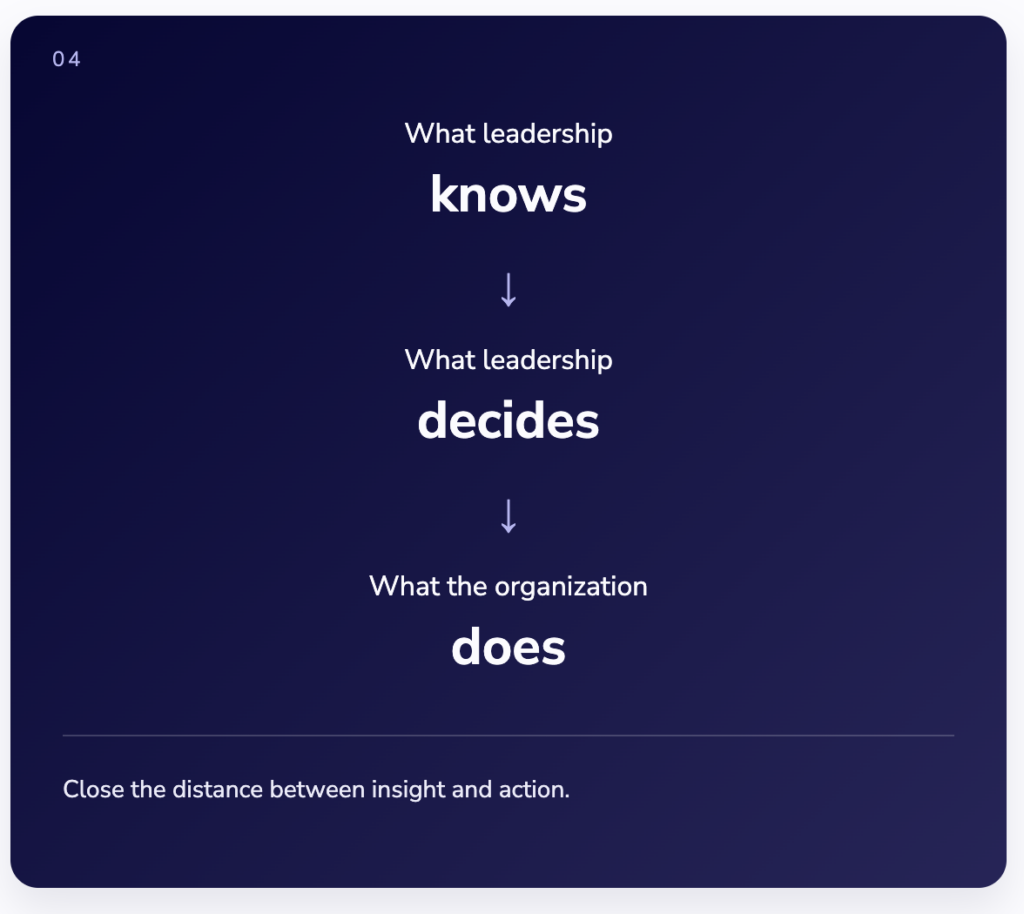
LIAM™—the Leadership Insight-to-Action Model—is Hinton Consulting’s leadership execution methodology.
It is applied when leadership alignment, prioritization, decision-making, communication, or executive behavior is materially affecting organizational performance.
LIAM™—the Leadership Insight-to-Action Model—is Hinton Consulting’s proprietary leadership execution methodology for helping organizations convert leadership insight, priorities, and decisions into coordinated action.
It examines where leadership alignment, decision-making, communication, prioritization, or executive behavior may be slowing or weakening organizational performance.
The methodology helps identify leadership blocks, clarify what requires executive attention, and translate decisions into defined actions, ownership, timelines, and operating expectations.
LIAM™ is especially useful when organizations have strong ideas or strategies but struggle to move them consistently through leadership and into execution.
It also helps reinforce decision discipline so leadership does not repeatedly fall back into unclear authority, competing priorities, or unresolved action.
Its purpose is to close the gap between what leadership knows and what the organization actually does.
What should we pursue?
What deserves priority?
Where should organizational resources be concentrated?
What should we deliberately not pursue?
What structures and systems must exist?
Where is the current operating model breaking?
What relationships, controls, workflows, or dependencies must change?
How will the strategy or framework become operational?
How will existing systems be integrated?
How will internal capability be developed?
How will ownership eventually transfer?
What is preventing leadership from moving insight into action?
Where are decisions stalling?
Are priorities competing?
Is authority unclear?
Are leadership behaviors reinforcing or undermining the operating system?
A central principle of the Hinton Consulting methodology architecture is that the problem determines the methodology—not the other way around. Organizations often lose time, capital, and momentum because they apply familiar solutions before determining what kind of problem actually exists.
A strategic problem should not automatically receive an operational solution. A systems problem should not automatically receive training. An implementation problem should not trigger another planning exercise. And a leadership problem should not be disguised as a workflow failure.
Each Hinton Consulting methodology is designed to address a different organizational condition: Strategy Compass™ establishes direction, ProSYS™ examines and redesigns organizational architecture, BUILD™ converts strategy into functioning capability, and LIAM™ strengthens leadership execution. Depending on the engagement, one methodology may be sufficient, several may work together, or the diagnostic process may reveal that a different intervention is required entirely.
Correct diagnosis determines correct intervention. The objective is not to apply more methodology. It is to apply the right methodology to the right problem at the right time.
“`
Processes become visible. Decision logic becomes explicit. Responsibilities become defined. Governance becomes repeatable. Standards become measurable. Knowledge becomes transferable. Improvement becomes systematic.
The organization becomes less dependent on individual memory and more capable of sustaining itself through defined systems.
A framework helps organize concepts.
A methodology governs how work is performed.
A template standardizes a document.
A methodology standardizes reasoning, decision-making, execution, validation, and improvement.
A complete methodology must be capable of answering questions such as:
This distinction is central to the way Hinton Consulting develops intellectual property.
Our methodologies are particularly relevant in operating environments where organizational weaknesses can quickly create consequences across multiple domains.
These environments include:
In these organizations, a single weakness can travel across the enterprise.
An operational problem can become a compliance problem.
A compliance problem can become a financial problem.
A financial problem can become a workforce problem.
A workforce problem can become a quality problem.
A quality problem can become a leadership problem.
Our methodologies are designed to examine those relationships before intervention begins.
Organizations need structure.
They do not need artificial standardization that ignores context.
Hinton Consulting methodologies are therefore designed to be both disciplined and adaptable.
The methodology provides the operating logic.
The application reflects the organization.
This allows our work to remain:
Repeatable enough to create reliability.
Adaptive enough to preserve relevance.
The same methodology may therefore be applied across different industries, organizational sizes, operating environments, and strategic conditions without assuming that every organization should produce the same solution.
Organizations become fragile when critical knowledge exists primarily inside particular people.
Someone knows how the process works.
Someone remembers why the decision was made.
Someone understands the workaround.
Someone knows which issue should be escalated.
Someone knows what leadership actually meant.
That is organizational dependency.
Methodology helps convert that dependency into institutional capability.
Processes become visible.
Decision logic becomes explicit.
Responsibilities become defined.
Governance becomes repeatable.
Standards become measurable.
Knowledge becomes transferable.
Improvement becomes systematic.
The organization becomes less dependent on individual memory and more capable of sustaining itself through defined systems.
Hinton Consulting methodologies are developed as institutional intellectual property rather than temporary consulting techniques.
Their development may include:
Over time, individual methodologies may support additional applications such as:
The consulting engagement is one application of the methodology.
It is not the methodology itself.
An organization may already know what it wants to accomplish.
The more difficult question is whether the organization underneath that ambition can support it.
Hinton Consulting methodologies help organizations examine that question from four different dimensions:
Direction.
Architecture.
Implementation.
Leadership Execution.
Because sustainable transformation requires more than knowing what should change.
It requires an organization capable of changing it.
Not every organizational problem requires another strategy.
Not every challenge requires restructuring.
Not every implementation problem requires more training.
The first task is determining what kind of problem you are actually solving.
Hinton Consulting helps organizations identify the underlying condition and determine the methodology, intervention, or operating architecture required to address it.


